
Millenary origins: from the dolmen to Roman rule
Llinars del Vallès has a history that is as old as it is fascinating. Although its name first appears in documents in the year 919, the territory had already been inhabited for thousands of years. One of the oldest testimonies is the Pedracra dolmen (2200–1800 BC), located near Vilalba Sasserra.
Later, the Iberian settlement of El Far, with more than 2,500 years of history, represented the first large consolidated human settlement in the area. The remains of Attic ceramics found at the site – which form part of the collection of the Joan Pla i Gras Museum – evidence the existence of commercial contacts with sailors from the Mediterranean East.
With the arrival of the Romans, local life underwent a profound transformation. The Via Romana, which today gives its name to a street in the Bona Sort neighborhood, opened Llinars to the world, favoring the introduction of cereal, vine and olive cultivation. According to tradition, this ancient path would have been trodden by Hannibal himself and his elephants during the Second Punic War, on his way to Rome.
Over time, the inhabitants came down from the hills and formed the village of Praetorio, the origin of Llinars, around what is now the CEIP Damià Mateu i Can Rossell. The remains of the Torre del Moro or Torrassa, at the top of the Serralada Litoral, are still a vestige of that era today.
The Middle Ages: castles, churches and vassalage
During the medieval consolidation, Llinars became a stable and religious centre, and in this context churches were built that still survive today, such as Santa Maria de Llinars (919), Sant Sadurní de Collsabadell (998), Sant Joan de Sanata (1003) and Sant Esteve del Coll (1023). At the same time, the lords of Castell del Far, vassals of the Counts of Barcelona, exercised feudal power over the territory.
At the same time, the Castell Vell, built between the 9th and 13th centuries on Iberian and Roman remains, became the symbol of this lordly domain. In the 12th century, control passed to the Desfar lineage, in a context of growing tensions with the Church. As a sign of spiritual and economic prosperity, a new church was consecrated in Collsabadell in 1133.
Later, the marriage between the Desfar girl and Romeu de Corbera caused the barony to pass to this new lineage, which is why the Corbera crow still appears on the coat of arms of the municipality. At the end of the Middle Ages, the population was distributed in several nuclei -Llinars, Collsabadell, Sanata and El Far-, with nearly 400 inhabitants, mostly farmers, some of whom were already beginning to combine field work with home textile production.
Finally, the earthquake of 1448 shook the territory and destroyed the Old Castle. In response, the peasantry agreed to collaborate in the construction of the New Castle, and in return, they were freed from feudal tribute for two generations. They contributed a thousand pounds, a collective gesture that still resonates today as a symbol of resistance and community.
From the countryside to the train: 16th to 19th centuries
Between the 16th and 19th centuries, Llinars was a peaceful agricultural town, where life revolved around working in the fields. The farmhouses scattered throughout the municipality were not only homes, but also centers of production and collective life, and many of them still form part of the landscape that defines the area today.
Despite this peaceful character, the town was also the scene of historical conflicts. On December 16, 1808, in the midst of the French War, the Catalan general Joan Miquel de Vives i Feliu tried to stop the advance of the Napoleonic troops commanded by Saint-Cyr. Despite the defeat, the Battle of Llinars was engraved in the collective memory of the municipality.
However, the most decisive change of this period came in September 1860, with the inauguration of the railway. The new connection with Barcelona not only improved communications, but also transformed the local economy, opened up new markets and prepared the town for the growth of the 20th century.
20th century: between war and transformation
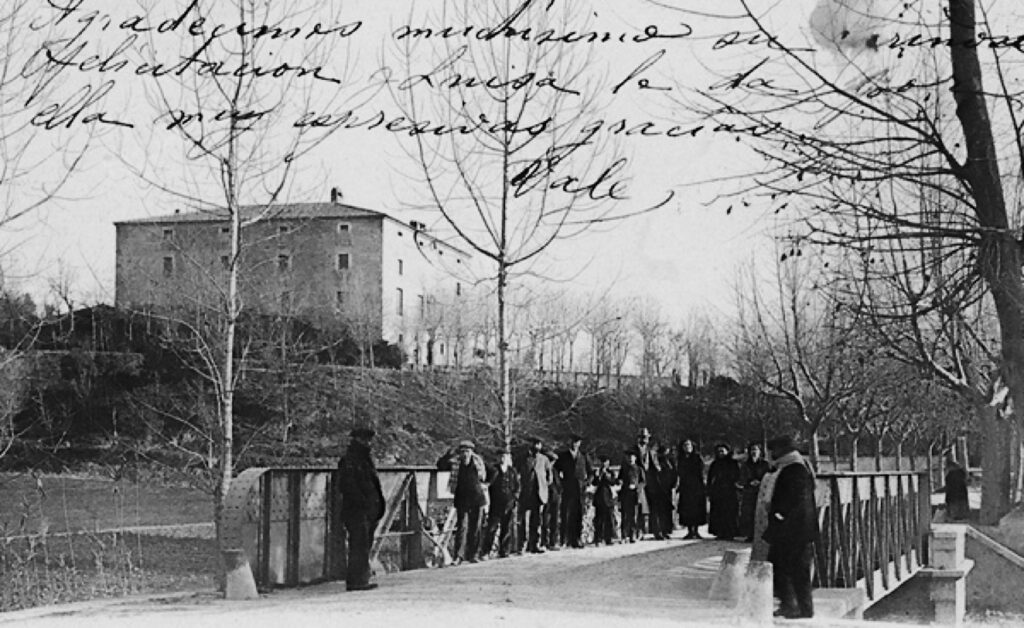
Throughout the 20th century, Llinars experienced a period of profound changes. During the Civil War, the municipality suffered serious damage: one of the most shocking events was the explosion of a truck loaded with trilite that destroyed the iron bridge over the Giola stream; furthermore, during the retreat of the defeated army, the town hall was left in ruins and more than 150 buildings were damaged, including the Miranda, inspired by Gaudí.
Despite the devastation, the post-war period was less harsh than in other areas thanks to agricultural and forestry activity. The Brotherhood of Farmers promoted the export of surplus potatoes, which helped keep the local economy alive.
Another notable phenomenon was the arrival of Barcelonan summer visitors, who came to enjoy the town’s good air and waters; among these visitors we find illustrious names such as Santiago Rusiñol, Frederic Marés or Damià Mateu. This tourism generated work and wealth for the local inhabitants, but also slowed down industrialization, as the summer visitors opposed the installation of factories.
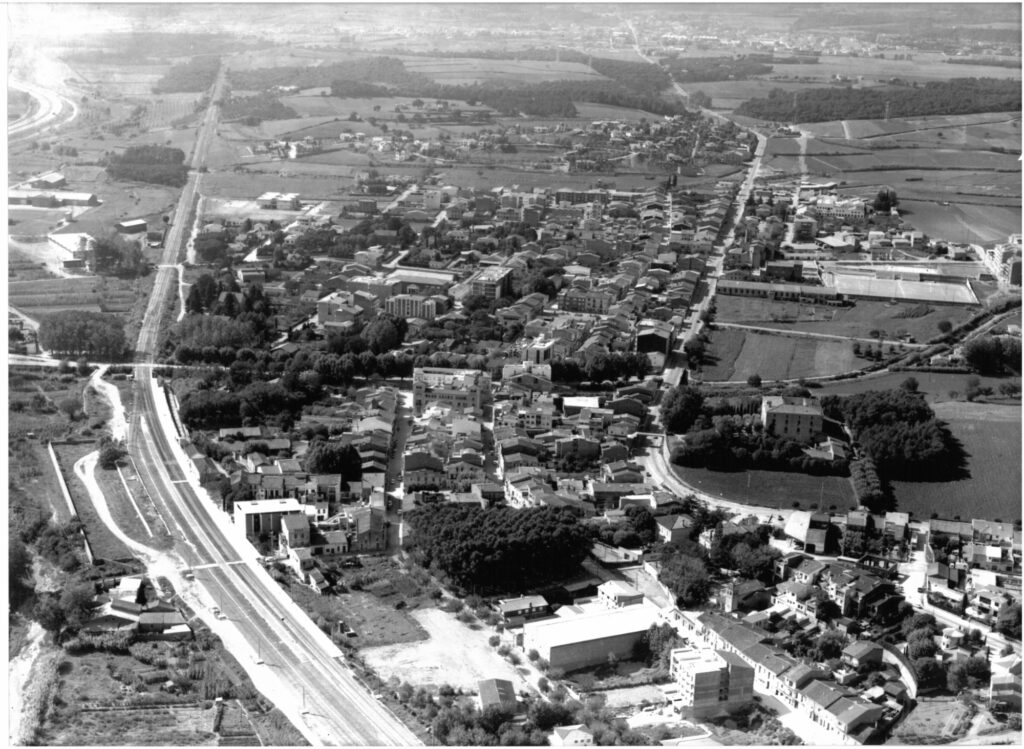
From the 1950s and 1960s, the arrival of families from other parts of the State, especially from Almería, and the creation of new urbanisations such as Can Boatell, Sant Josep and Sant Carles, led to strong demographic and urban growth, forcing improvements to infrastructure and basic services such as water, sewage and education. With democracy, the first plural town council was built, led by Miquel Jané, in a moment of renewal and collective hope.